Sunday, May 22, 2016

Bex: Australia’s APC cure-all that was addictive and caused kidney damage (?)


The story below is conventional but unbalanced.  Phenacetin is said to be the ingredient in APC powders that caused kidney damage but what does it metabolize to in the body? Paracetamol!  Precisely the analgesic that is now generally recommended.  How crazy can you get?  And paracetamol (aka acetaminophen) IS dangerous by itself, but not for its effect on the kidney. It destroys the liver!  It is very dosage-sensitive. If you take much more than the recommended dosage, you can die.

So how come people took huge doses of phenacetin and did NOT die of liver disease?  And aspirin in large doses can be toxic too, though not nearly as toxic as paracetamol.  So people were taking huge doses of both paracetamol and aspirin without experiencing the symptoms that should have gone with that.  So again, How come?

It seems that the APC combination produced some sort of beneficial drug interaction.  The three ingredients seemed to combine to eliminate the toxicity they had by themselves.  Stranger things have happened.  But divine miracles are rare so to a small degree the APC combination also caused some damage -- but only to the kidneys and only among heavy users of the powders.  And the mortality from liver disease is now much greater than the mortality that used to be experienced from kidney disease.

So APCs were in fact a wonder drug that became harmful only from heavy over-use.  And ANYTHING can be harmful in excess.  Even drinking too much water can kill you.  Google "hyponatremia" if you doubt it.

Another problem is that many Bex users went onto Valium instead when Bex was withdrawn -- with its attendant risk of making you drowsy when you're driving. So did the ban on Bex kill people in road accidents? Probably.

And a VERY important use of Bex was as an early treatment for what is still a dreaded and all too common ailment: migraines. Migraine sufferers generally get some warning when a migraine is due to strike, an aura, jaw stiffening etc. And as soon as anybody prone to migraines felt the slightest suspicion that one was about to strike, they would grab their nearby packet of Bex and slam one into themselves quick smart. And it did help. If you got the Bex into yourself straight away, the migraine would either not develop or would be less severe than a full-blown attack.

Now here's the final kicker: Something that is often prescribed for aches and pains these days is NSAIDS (Ibuprofen etc.). And guess what is a major side effects of NSAIDS? Kidney damage. NSAIDS are hundreds of times more toxic to the kidneys than Bex ever was. So let's ban NSAIDS!

So I know I am telling here a story that is at great variance with the conventional wisdom but everything I have said above is entirely factual.  There was some research in the 1960s that pointed to the benefits of the APC combination but it was not pursued, presumably because the usefulness of APCs was seen to be beyond question and needing no reinforcement

A more extensive coverage of the issues is <a href="http://john-ray.blogspot.com.au/2010/04/great-phenacetin-folly-phenacetin-was.html">here</a>

I am inclined to suspect that the main reason for banning APCs such as Bex was because they were so popular.  That HAD to be bad


WHEN former prime minister Kevin Rudd told journalists speculating that he was trying to reclaim the Labor leadership to have "a cup of tea, a Bex and a good lie down", younger members of the media pack look puzzled.

They had not heard such an expression before, but to the children of the Baby Boomer generation, the phrase was immediately recognisable.

It was in the late 1950s and throughout the ’60s that the marketing slogan entered the vernacular. Bex, the analgesic made up of aspirin, phenacetin and caffeine (APC), became an Australian icon. It was recommended to treat aches and pains, headaches, colds, flu, fevers, rheumatism and for "calming down".

Dissolving a Bex (or the similar product, Vincent’s) in a cup of tea, or taken with other stimulants such as cola drinks became particularly common among housewives. It was widely available and sometimes taken up to three times a day.

Aggressive marketing from drug companies meant it was even common to pop a Bex or Vincent’s powder in children’s lunch boxes "just in case".

It wasn’t until the 1970s that doctors and health experts realised these formulations were responsible for kidney disease and addiction, and were carcinogenic. Phenacetin was finally pulled from the market by the late ’70s. But the damage had already been done. In the years that followed World War II, Australia led the world in APC consumption — and in the number of deaths it eventually caused.

Women resorted to "a cup of tea, a Bex and a good lie down" so often that in 1965 it became the title of a popular play by John McKellar.

The phrase is still instantly recognised by the children of that generation. So many people had an aunt, a mother, a sister, or a friend who were addicted to APCs. Many of them died from related kidney disease.

Readers of our Adelaide Remember When Facebook page recently responded to a post on the Bex phenomenon with memories of their own experiences.

Rick Cooper wrote: "For a while, I lived in Hamley Bridge and the railway was the playground, transport and just about everything else for us kids. At one stage, Vincent’s had a sign on every fence along the railway lines with the countdown in miles until you reached Adelaide. The blue, yellow and white signs said ‘X miles to relief with Vincent’s powders’."

Trish Simpson recalled how her father was addicted to Bex and ended up with terrible kidney problems: "We always had Bex in the house and I remember taking them when I was younger. Eventually they removed the damaging ingredient and Bex wasn’t as effective. Not sure how much longer they survived after that."
Vincent’s Powders and Bex with aspirin and cold medicine on the shelf in 1979.

Deborah Wise reminisced that as a child she loved Bex: "If we had a sore throat, Mum would mix a powder in a teaspoon of honey. Man, it tasted good! I suppose it eased the symptoms as well. I’m pretty sure that my Dad used to take a Bex first thing every morning."

And Adele Andrews contributed: "I was an operating room nurse in the late 1960s and one of Adelaide’s top renal surgeons gathered all the OR staff into the theatre one day to show them a shrivelled-up kidney he had just removed from a 32-year-old woman. All he said was ‘Bex powder addiction, take note’. I had never taken any APC and was not about to start after that lecture. They should have been banned much earlier."

Concerns about the rates of consumption of the popular analgesics first surfaced in 1962 and resulted in a series of public health warnings.

They seemed to have a minimal impact until 1966, when kidney specialist Priscilla Kincaid-Smith — after noticing a serious rise in women presenting with kidney disorders — conducted a series of experiments on rats.

She proved that APC powders were linked to serious kidney disease and the Government of the day began to take notice. In 1967, the National Health and Medical Research Council recommended that phenacetin be removed from the pharmaceutical benefits list, which saw Vincent’s eliminate the compound from its powders that same year, replacing it with salicylamide, which was from the same chemical family as aspirin.

Bex, however, continued to include phenacetin in its product but the sustained adverse publicity throughout the 1970s and the mounting evidence that the once "harmless" cure-all was in fact causing serious kidney disease, forced Bex to also drop the substance from its powders in 1975. By 1977, the results of the addiction were becoming very clear and the NH & MRC moved to restrict the availability of all APCs.

And so the Bex and Vincent’s powder era, thankfully, came to an end.

Thinking back to those days, it was just part and parcel of the lifestyle. Just about everyone’s mum or grandma seemed to always have a Bex or Vincent’s powder handy and, with the first sign of a headache, a cold or if they felt they needed a quick "pick me up", down would go a powder.

It was a vicious circle of addiction, really: the caffeine content gave a sudden rush of energy, which eventually triggered a withdrawal headache, which prompted them to take another powder

http://www.adelaidenow.com.au/news/south-australia/bex-australias-apc-cureall-that-was-addictive-and-caused-kidney-damage/news-story/5b5ec0121b5c6feec3c6f226a1781a66


Tuesday, May 10, 2016

Here's why you wake up in the morning with 'sleep in your eyes'


There are plenty of reasons why waking up in the morning is the grimmest thing we'll do all day.

But daybreak is even more dolorous if we're unlucky enough to wake up with our eyes glued shut.

When this happens, we generally say that we've awoken with 'sleep in our eyes'.

But in America, the horrid peeper adhesive is called "eye boogers" - which makes it sound a million times more disgusting.

Now the science experts from a YouTube channel called SciShow have stepped in to explain the make-up of this yucky substance.

Michael Saranda, host of the show, said : "Mr Sandman, I asked you to bring me a dream and you brought me were these gross eye boogers.

"So what is this goopy junk which collects in the corners of my eyes while I'm asleep?"

He explained that scientists don't have an official name for the "crusty residue", although it is often referred to as rheum or gound.

Rheum is always present in the eye, which uses a liquid called "tear film" to keep the peeper lubricated.

When we wake up, the tear film has gathered in our eyes because we haven't been blinking.

It has also become mixed with oil, bacteria, dust and skin cells to produce a sticky substance which glues the eye shut.

"Before you know it you have eye boogers in all their crusty, cruddy glory," Saranda added.

Americans also refer to eye boogers as "dream dust" and "sleep sand" - which, in Britain, would probably be names given to legal highs.

http://www.msn.com/en-au/health/medical/heres-why-you-wake-up-in-the-morning-with-sleep-in-your-eyes/ar-BBsGTL0


Saturday, November 7, 2015

My war with ‘Wow!’


Plus: The posthumous wit of Oscar Wilde and the curious poignancy of Murder, She Wrote

Barry Humphries

I’m counting ‘Wows!’ Suddenly everyone is using this irritating expletive expressing incredulity, amazement and nothing at all. I’ve heard it from the lips of daughters in law, professors of literature, rabbis and housewives. No doubt at least one priest has said it after a particularly lurid confession. It is spreading like leprosy over ordinary discourse and will, in time, die out like ‘Zounds’ or ‘Gee whizz’. I wonder if it will turn up as an anachronism in Downton Abbey? I saw on television the other night a superb production of Priestley’s An Inspector Calls with great performances from David Thewlis, Ken Stott and Miranda Richardson. The adaptation was impeccable and no one said ‘Wow!’ but there was a jarring moment when one actor referred to ‘the bottom line’, briefly wrenching me back into the present.

Another star-studded celebration of Oscar Wilde (his birthday) at the Langham Hotel, hosted by Gyles Brandreth and Oscar’s grandson Merlin Holland. Some ignorant malapert said in the Observer the other day that Wilde never wrote anything when he came out of the slammer. What about De Profundis and the post-vinicular Ballad of Reading Gaol? And what about his voluminous discarnate witticisms, many dictated in automatic writing to Mrs Hester Travers Smith, the distinguished medium. ‘Being dead is the most boring experience in life, if, that is, one excepts being married or dining with a schoolmaster.’

I’ve lately fallen into the habit of chewing the right corner of my lower lip in moments of scepticism. I know why I do it. It’s an unconscious homage to that great actor Michael Kitchen, who invented this mannerism for his flawless impersonation of Christopher Foyle in my favourite TV show. I’ve watched Foyle’s War countless times and my admiration for the writer Anthony Horowitz, Mr Kitchen, glorious Honeysuckle Weeks and their satellites continues to grow. John Betjeman would certainly have worshipped Sam in her ATS uniform and lyle stockings. If Hester Travis Smith was still with us, I’m sure that Betjeman would send her Ouija board spinning at the mere whiff of Honeysuckle.

Other shows I enjoy late at night on my new TV set are Murder, She Wrote and The Professionals, the latter for its pacey, modern camerawork and its glimpses of old London in the far-off 1970s, when phones rang and characters picked up cordless handsets the size of small cars. Angela Lansbury’s wonderful series set in Cabot Cove — surely the murder capital of the world — is riveting, not just because one can never get enough of Angela Lansbury, but because all the male characters have terrible wigs and the women have hair and shoulders that fill the screen. Some of these late-night diversions have, for me, a certain poignancy as I count the few cast members who are still alive.

Last weekend I was in Nice with Jennifer Saunders and Joanna Lumley for their new Ab Fab movie. I played a small but striking role as the sleazy old boyfriend of Patsy at a pool party festooned with Russian babes. My usual theatrical work is rather solitary, so this was a heart-warming tonic. Later, gorgeous Miss Lumley and I dined in a modest bistro, but I noticed a middle-aged couple at a nearby table were staring rather hard at my companion. ‘ENT,’ I whispered across the table. It was my mother’s customary acronym when, during my early schooldays, she took me to one of her ladies’ luncheons in a Melbourne tea shop and noticed a rather conspicuously dressed couple at a nearby table: the woman rather loud and toothy, the man in mustard-coloured corduroy trousers, suede shoes and houndstooth jacket with un-Australian side vents. ‘ENT.’ English Next Table. Sure enough the star of Absolutely Fabulous had been clocked by a British tourist. ‘I’m so sorry to interrupt your privacy,’ he said, husky with reticence. He then politely expressed his admiration for several of Miss Lumley’s achievements; compliments she received with her habitual grace. Oddly enough, I went unrecognised, although on reflection the nice man from Ealing might have been too awestruck to accost me.

On the Côte d’Azur the dead have the best views; it made me think of Gstaad, where the best aspect of the valley is from a hostel for the blind. I drove over to Menton yesterday and climbed the hill to the cemetery to pay my respects at the tombs of Aubrey Beardsley and Katherine Mansfield. A night off last Saturday in the restaurant at the Negresco in Nice, a marvellous belle époque hotel which, alas, has been expensively ‘reimagined’ by a colourblind decorator and kitsch-meister and been utterly ruined. ‘Vulgarity is the rich man’s modest contribution to democracy,’ posthumously quipped Oscar Wilde to Mrs Travers Smith in 1928. Wow!

http://new.spectator.co.uk/2015/10/barry-humphriess-diary-my-war-with-wow/

Thursday, September 10, 2015


Food fight : the origins of Australian cult foods up for debate


Forget politics. Or religion. Same-sex marriage? Nuh-uh.

The best way to ensure some robust debate between friends (especially those interstate or international) is to claim ownership of a certain foodstuff.

Don't believe us?

Take the Neenish Tart.

Essays have been written about the origins of the humble staple of country bakeries nationwide and still, the matter is not settled.

Indeed, the Sydney Morning Herald's famed Column 8 has devoted column inches to the contentious matter in a highly entertaining debate between readers over the years. 

Some believe the tasty pastry came from the kitchens of one Ruby Neenish, of Grong Grong, NSW.

Others believe that story, and Mrs Neenish herself, are a fiction.

The earliest recorded recipe of the bi-coloured bite can be found in Miss Drake's Home Cookery, written by Lucy Drake, published in 1929 in Glenferrie, Victoria.

The CWA, for their part, have laid strong claim to the tart, those of German and Austrian descent proffer their own links but we must assume, its true birthplace might never be known.


A Giant Neenish Tart? Controversial. 

So in the sweet spirit of taking a bite out of each other, we bring you our top seven foods claimed to be all-Australian - both contested and confirmed in their beginnings.


The Chiko Roll

The Aussie classic (that, in fact, contains no chicken) was invented by Frank McEncroe, born in Castlemaine but later a boilermaker from Bendigo, Victoria - both towns claim him as a favoured son.

In 1950, McEncroe saw a competitor selling Chinese chop suey rolls outside Richmond Cricket Ground and hit upon the idea of a substantial snack that could be held in one hand leaving the other free for more important business at the footy - opening a cold one, for instance.

The Chiko Roll, debuted at the Wagga Wagga Agriculture Show in 1951 but made a triumphant return to the southern state in 1960s, McEncroe moved to Melbourne with his family and began to manufacture the rolls en masse.


The Meat Pie

Woah Nelly! The meat pie an Australian invention? Many, many countries lay claim to the mighty meat pie, firstly by Ancient Egyptians (9500 BC), Greeks, Romans, the English, Latin Americans and on and on and on.

But, you'd be inviting trouble if you denied Australia fair bragging rights in the invention of the snack in its current form.

One of the most famous was first produced in 1947 by L. T. McClure in a small bakery in Bendigo and was destined to become the famous Four'N'Twenty.

Older still, Sargents Pies can trace their pie making back to 1906, but George, Charlotte and Foster Sargent - before they lit out on their own - had already been selling pies for a penny in a small shop in Paddington, Sydney since 1891.

In South Australia, Balfours and Vili's have both been making pies for more than 100 years.

Which brings us to…


The Pie Floater

The pie floater - an upside-down pie in a bowl of pea soup, topped with either tomato sauce or, sometimes, Worcestershire Sauce (controversial, we know) - was reputedly invented by a South Australian Port Pirie baker known as Ern 'Shorty' Bradley at the turn of the 20th century. Woolloomooloo's Harry Cafe De Wheels deserves an honourable mention for having served the, uh, attractive dish since it opened its shutters in 1938. 


The Lamington

Most of the argy-bargy surrounding the origins of the Lamington concern the name - while most agree it was named after Lord Lamington, who served as Governor of Queensland from 1896 to 1901, although some reckon it was for his wife, Lady Lamington. Another account reckons they were named after the Scottish village of Lamington, South Lanarkshire, however this may be pure semantics as the Lord hailed from Lamington and now we are splitting coconut flakes…

It is mostly accepted the treats were first served in Toowoomba in 1900 when Lord Lamington took his entourage to Harlaxton House to escape the heat of Brisbane.


The Dim Sim

Invented right here in Melbourne by Chinese chef William Wing Young for his restaurant Wing Lee around 1945.

But the mighty meaty dim sim really got its cult following at the South Melbourne Markets sold by Melbourne legend Ken (Kuen) Cheng from 1949 until his death in 2006. Vale.


The Iced Vovo 

Kevin Rudd poured a giant cup of cold tea on the Labor Party faithful's celebrations at being returned to power after 11 years in the wilderness in 2007 by suggesting everyone calm down and have an Iced Vovo.

But a greater shock to the system is that the iconic jammy biscuit isn't actually ours.

Or so those dastardly New Zealand types would have us believe. Apparently a Kiwi biscuit company going by the name Auselbrooks, established in the 1860s, were making Iced VoVos well before Arnotts registered the name.

And Arnotts have quietly acknowledged this to be true.

Humph. Enough to make one take a Bex and have a good lie down.


The Pavlova

Ah. The great bone of contention between Australians and our Kiwi cousins.

So the story goes like this. (The real story. Promise).

Inspired by visits by the Russian ballerina Anna Pavlova during her 1926 and 1929 tours of Australia, Western Australian chef Herbert Sachse of Perth's Hotel Esplanade created a confection that was "as light" as the prima ballerina herself. End of story.

Except, these origins are heavily disputed by New Zealanders who claim their cookbooks have older versions of the fruity, creamy, light, delicious summer dessert.

Likely story.


Anyway, you can always complement your meal - pie floater, meat pie, Pavlova, anyone? - with a glass or two of "plonk".

It's a term that came from Australian soldiers on the Western Front in France during World War I.

To their untutored ears, vin blanc - white wine - sounded like "plonk".

They adopted it as their word for all forms of wine, and brought it home, where it stayed. So it's a well-travelled term.

And it's ours.


Wednesday, September 2, 2015

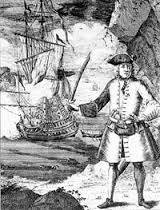
Henry Every: The King of Pirates


Henry Every (or Avery) is remembered for capturing the richest pirate prize ever and also for apparently being wise enough to retire from the business and enjoy his ill-gotten gains. 

He was born in the West Country of England, famous for providing England with a large percentage of its seafarers.  He served briefly in the Royal Navy, and then moved on to the slave trade, where the pay was better although dishonorable. 

In 1693, he was serving as first mate on the Spanish privateer Charles II when the crew became disgruntled and mutinied.  The ship was renamed Fancy and Every was elected captain.  After plundering ships off West Africa, they moved into the Indian Ocean. 

In 1695, the Fancy had reached the Red Sea and joined up with a number of other pirates.  They launched an uncoordinated attack on the Mughal treasure fleet that included the main treasure ship Ganj-i-sawai and the smaller Fateh Muhammed. 

Thomas Tew, commanding the pirate sloop Amity, was killed in an attack on the Fateh Muhammed.  The Mughal ship, though, had incurred significant damage from that attack and was unable to withstand a second attack by Every on the heavily-armed Fancy.  Every then turned his attention to the even larger Ganj-i-sawai, capturing it also. 

The pirate crew was incensed by the damage inflicted by the Indian vessels and promptly tortured and killed most of the Indian sailors and soldiers on board.  They also attacked the Indian women on board, many of whom committed suicide to escape their fate. 

The treasure on the two Indian ships was enormous, with an estimated value of £600,000.  Every’s share made him the richest pirate in history. 

Because Britain was seeking good relations with the Mughal Empire, it launched a worldwide manhunt for Every and his crew.  They had fled to the Bahamas, where they divided the treasure and split up.  Many, though, were eventually captured, tried, convicted, and hanged. 

Henry Every was never heard of again.  Rumors circulated that he had changed his identity and assumed a quiet life back home in the West Country, but there was no evidence to support the story.

http://www.maritimeprofessional.com/blogs/post/henry-every-14871

Tuesday, September 1, 2015

Gough Island: One of the most remote and pristine islands in the world


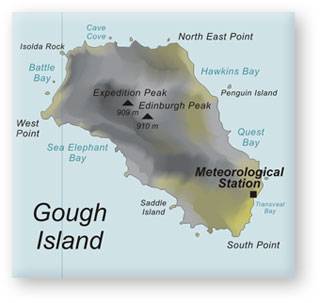
Gough Island in located in the South Atlantic Ocean, somewhat closer to Africa than to South America, being 2,000 miles from South America while a mere 1,500 miles from Africa.  It is about 250 miles south-southeast of the Tristan da Cunha group.  It is part of the United Kingdom Overseas Territory of St. Helena, Ascension, and Tristan da Cunha. 

There is no permanent human habitation except for a six-person meteorological team from South Africa that changes out with new individuals each year. 

The island and its outlying rocks cover approximately 35 square miles.  The highest elevation, Edinburgh Peak, rises to a height of almost 3,000 feet. 

The island was discovered by Gonçalo Álvares in 1505 when he nearly bumped into it while on a voyage from Portugal to India.  It was visited briefly by an English mariner in 1675 and then neglected until 3 March 1732 when it was visited and accurately charted by the British merchant Charles Gough. 

During the nineteenth century Gough Island was occasionally visited by sealers.  It was formally claimed by the UK in 1938. 

Due to its minimal human contact and its distance from large landmasses, Gough Island is one of the least-disrupted marine ecosystems in the cool temperate zone.  There are no indigenous mammals and the last rats have been eradicated.  It is home to one of the largest colonies of sea birds and to two endemic species of land birds – the almost flightless Gough moorhen and the Gough finch.  There are also twelve endemic species of plants. The island hosts 22 species of seabirds, including albatrosses and petrels, as well as penguins. 

It is of volcanic origin, sharing the same submerged mantle plume as Tristan da Cunha, but is composed of more ancient material described as of Large Low Shear Velocity Providence (you have to admire the ingenuity of geologists to come up with such a term).

While the volcano on Tristan da Cunha is active, the one on Gough Island is long extinct.

http://www.maritimeprofessional.com/blogs/post/gough-island-14879


Tuesday, July 21, 2015


One Diagram That Will Change the Way You Look At the US Economy

The US is by far the largest economy in the World, with a nominal GDP of $17.4 trillion in 2014. However, it is not the World leader in all economic sectors: the US is a service-based economy, with a smaller focus on agriculture and industry than other countries (though its industrial and agricultural sectors are still the second- and third-largest in the World due to the sheer size of the US economy).


The graphic above (Voronoi diagram) represents the relative size of each country’s economy in terms of nominal GDP: the larger the area, the larger the size of the economy. The areas are further divided into three sectors: services, industrial, and agricultural. The US economy is mostly composed of companies engaged in providing services (79.7% compared to the global average of 63.6%), while agriculture and industry make up smaller-than-average of portions of the economy (1.12% and 19.1% compared to averages of 5.9% and 30.5%).

The next largest economy, China, is roughly balanced between industry and services (though the service sector is growing at a faster rate), with a 9.1% contribution from agriculture. In this sense, China is a bit of an anomaly: other rich countries have service sectors that greatly outweigh both industry and agriculture. Over the past several decades, China has leveraged its competitive advantage and designed industrial policies to incent manufacturing in the country. But as China grows, it will continue to transition to a service-based economy. Similarly, India will see a decrease in agriculture’s contribution to its GDP and an increase in the size of the service sector.

Over time, the service sectors of developed nations have tended to grow relative to the other sectors. But are there limits to this trend? What is the natural size of each sector?

http://howmuch.net/articles/one-diagram-that-will-change-the-way-you-look-at-the-us-economy