Wednesday, September 25, 2019


Scientists have discovered evidence of an ancient kingdom previously thought to have been a mythical creation in the Bible.


The Old Testament described Edom as a neighbouring enemy state of Judea, located southeast of the Dead Sea where explorers would now find parts of Jordan and Israel.

It was spoken of extremely harshly, with some biblical texts indicating that it was complicit in the destruction of Judea and the holy city of Jerusalem.

Edom has been described as a place "where kings reigned before any Israelite king reigned", but is later said to have been defeated and plundered by King David of Israel.

Such tales have been scoffed at by plenty of historians down the years, but discoveries by a team of scientists and archaeologists in the area where it would have stood have raised new questions about its possible existence.

Researchers from the University of California and Tel Aviv University have been working at the supposed site in what is now known as the Arabah Valley.

There they excavated a copper production site dubbed Slaves' Hill, dating back more than 6,000 years, which yielded layers of smelting waste that have helped reconstruct a time when the region enjoyed a "technological leap".

Using a process called radiocarbon dating, which helps determine how old an organic object is, the researchers were able to put a date on the smelting waste - better known as slag.


The modern day Arabah Valley

Analysis of the minerals and metals within the slag was then used to work out how smelting techniques changed over the centuries, with lower concentrations of copper indicating that more had been extracted.

Efficiency improved dramatically in the second half of the 10th century BC and the techniques also became common across various sites in the region - indicating that other workers were picking them up.

Detailing the findings in the journal PLOS ONE, team leader Erez Ben-Yosef said the technological leap played a key role in the move from the Bronze Age to the Iron Age.

"Our study sheds new light on the emergence of the archaeologically elusive biblical kingdom of Edom, indicating that the process started much earlier than previously thought," he said.

"That said, the study's contribution goes beyond the Edomite case, as it provides significant insights on ancient technological evolution and the intricate interconnections between technology and society.

"The results demonstrate that the punctuated equilibrium evolutionary model is applicable to ancient technological developments, and that in turn, these developments are proxies for social processes."

https://www.msn.com/en-au/news/world/ancient-kingdom-presumed-to-be-bible-story-could-be-real/ar-AAHPrBR?OCID=ansmsnnews11


Saturday, September 7, 2019


Modern-day Indians are descendants of one of humanity's most ancient civilizations


Ancient DNA evidence reveals that the people of the mysterious and complex Indus Valley Civilization are genetically linked to modern South Asians today.

The same gene sequences, drawn from a single individual who died nearly 5,000 years ago and was buried in a cemetery near Rakhigarhi, India, also suggest that the Indus Valley developed farming independently, without major migrations from neighboring farming regions.

It's the first time an individual from the ancient Indus Valley Civilization has yielded any DNA information whatsoever, enabling researchers to link this civilization both to its neighbors and to modern humans.

The Indus Valley, or Harappan, Civilization flourished between about 3300 B.C. and 1300 B.C. in the region that is now covered by parts of Afghanistan, Pakistan and northwestern India, contemporaneous with ancient Egypt and Mesopotamia.

The people of the Indus Valley forged an impressively advanced civilization, with large urban centers, standardized systems of weights and measurements and even drainage and irrigation systems. Yet despite that sophistication, archaeologists know far less about the civilization than that of ancient Egypt or Mesopotamia, in part because the Indus Valley writing system hasn't yet been deciphered.

Gathering ancient DNA from the Indus Valley is an enormous challenge, Vagheesh Narasimhan, one of the leading authors of the new research and a postdoctoral fellow in genetics at Harvard Medical School, Live Science, because the hot, humid climate tends to degrade DNA rapidly. Narasimhan and his colleagues attempted to extract DNA from 61 individuals from the Rakhigarhi cemetery and were successful with only one, skeleton likely belonging to a female which was found nestled in a grave amid round pots, her head to the north and feet to the south.

The first revelation from the ancient gene sequences was that some of the inhabitants of the Indus Valley are connected by a genetic thread to modern-day South Asians. "About two-thirds to three-fourths of the ancestry of all modern South Asians comes from a population group related to that of this Indus Valley individual," Narasimhan said.

Where the Indus Valley individual came from is a more difficult question, he said. But the genes do suggest that the highly agricultural Indus people were not closely related to their farming neighbors in the western part of what is now Iran.

"We were able to examine different associations between the advent of farming in that part of the world with the movement of people in that part of the world," said Narasimhan.

Farming, Narasimhan said, first began in the Fertile Crescent of the Middle East around 10,000 years ago. No one knows precisely how it spread from there. Did agriculture pop up independently in areas around the globe, perhaps observed by travelers who brought the idea to plant and cultivate seeds back home? Or did farmers move, bringing their new agricultural lifestyle with them?

In Europe, the genetic evidence suggests that the latter is true: Stone Age farmers introduced Southern Europe to agriculture, then moved north, spreading the practice as they went.

But the new Indus Valley genetic evidence hints at a different story in South Asia. The Indus Valley individual's genes diverged from those of other farming cultures in Iran and the Fertile Crescent before 8000 B.C., the researchers found.

"It diverges at a time prior to the advent of farming almost anywhere in the world," Narasimhan said. In other words, the Indus Valley individual wasn't the descendent of wandering Fertile Crescent farmers. She came from a civilization that either developed farming on its own, or simply imported the idea from neighbors — without importing the actual neighbors.

Both immigration and ideas are plausible ways to spread farming, Narasimhan said, and the new research suggests that both happened: immigration in Europe, ideas in South Asia. The results appear today (Sept. 5) in the journal Cell.

Complex populations

The researchers also attempted to link the Indus Valley individual to his or her contemporaries. In a companion paper published today in the journal Science, the researchers reported on ancient and modern DNA data from 523 individuals who lived in South and Central Asia over the last 8,000 years.

Intriguingly, 11 of these people — all from outside the Indus Valley — had genetic data that closely matched the Indus Valley Individual. These 11 people also had unusual burials for their locations, Narasimhan said. Together, the genetic and archaeological data hint that those 11 people were migrants from the Indus Valley Civilization to other places, he said.

However, these conclusions should be viewed as tentative, warned Jonathan Mark Kenoyer, an archaeologist and expert on the Indus Valley Civilization at the University of Wisconsin, Madison, who was not involved in the new research. Archaeological evidence suggests that Indus Valley cities were cosmopolitan places populated by people from many different regions, so one person's genetic makeup might not match the rest of the population. Furthermore, Kenoyer said, burial was a less common way of dealing with the dead than cremation.

"So whatever we do have from cemeteries is not representative of the ancient populations of the Indus cities, but only of one part of one community living in these cities," Kenoyer said.

And though the Indus individual and the 11 potential migrants found in other areas might have been related, more ancient DNA samples will be needed to show which way people, and their genes, were moving, he said.

Narasimhan echoed this need for more data, comparing the cities of the Indus Valley to modern-day Tokyo or New York City, where people gather from around the world. Ancient DNA is a tool for understanding these complex societies, he said.

"Population mixture and movement at very large scales is just a fundamental fact of human history," he said. "Being able to document this with ancient DNA, I think, is very powerful."


https://www.livescience.com/south-asians-descend-from-harappan-civilization.html

Thursday, September 5, 2019


Cows have the right of way, the phone book features nicknames and homes are sold with the furniture thrown in


Norfolk Island, which is roughly 1500kms off Byron Bay, has a host of fun facts under its belt — like how there are no traffic or street lights — but perhaps the most surprising is that the peaceful and picturesque South Pacific island has a median house price of $400,000.

A place most of us have heard of, but know little about, Norfolk Island was for a long time an Australian territory with quirky laws restricting the purchase of real estate to those who were born on the island, married an islander or bought a local business.

In 2015, the remote island underwent historic changes to ownership rules when the Australian government announced comprehensive reforms. Since then, the dreamy locale has opened up to a world of new househunters. Originally only people born on the island could buy there — but that’s now changed.

“It’s now the same as if you’re moving from Sydney to Melbourne, there are no restrictions whatsoever for Australians and New Zealanders,” said David Hall, a local real estate agent who has been selling property on the 35sq km island for more than a decade.

“Up until Australia took over, prior to that, it was different.  “The Norfolk Island Government had an immigration policy so you couldn’t just come here and live. You could buy a house, but only live here for up to three months and that was restrictive.

“The only way you could buy and live here permanently back then was to buy a business, run that business for five years, and then after that period if you’d behaved yourself, you could apply for residency.”

The Australian external territory, which was home to 1748 residents at the last Census, is located at the centre of a triangle made up of Australia, New Zealand and New Caledonia.

It is just 8km long and 5km wide, has one solitary roundabout, no public transport, a maximum speed limit of 50km and peak hour only exists when the local livestock take to the streets.

As well as speaking English, locals have their own living language. Norfuk is a blend of eighteenth century English and Tahitian derived from the original settlers on the island.

While there were no indigenous people recorded on the island at the time of European settlement, the descendants of Tahitians and the HMS Bounty mutineers, including those of Fletcher Christian, were resettled on Norfolk from the Pitcairn Islands.

As a result, the Norfolk Island phone book has a “faasfain” (or fast find) section featuring nicknames, rather than surnames, because so many of the locals share just a few family names.

Mr Hall said life on the island is simple, but that’s just the way locals like it and now more mainlanders than ever are buying their own slice of the property paradise.

“The sales volume has gone up, probably nearly doubled since Australia took over and that’s been fantastic. People who want to retire are happy because they don’t have to work, they can come over here now and just retire. And why not, it’s one of the safest, cleanest and most beautiful islands in the Pacific,” he said.

“It’s so safe here that the only cars you find in the street that will be locked will be those of tourists, because they can’t get out of the habits of mainland Australia.”

While retirees are definitely taking note of Norfolk Island, with the median age almost a decade older than the rest of the country at 49, Mr Hall said there is also plenty on offer for aspiring residents of all ages.

“Kids can ride their bikes to school and don’t have to be taken by their parents. It is so safe you can walk the streets day or night, in complete safety. It’s unique, it’s really lovely. We don’t have street lights, but most people have a torch,” Mr Hall added.

Norfolk Island’s local school caters for more than 300 children from Kindergarten to Year 12 and according to Census 2016, there were officially only 16 unemployed people.

“If you’re over here and you’re not working, it’s because really you don’t want to work,” explained Mr Hall.

“We’re also getting more people who are working via the internet, now we’ve got the NBN,” he said, adding that there is a need for more traditional talent as well.

“We have quite a few really good builders, we have a couple of timber mills, three joiners, a heap of plumbers and electricians. But there is a shortage, basically, of tradespeople, because they’re all so busy.”

The unique island, which is home to just over 1000 houses, has an unusual real estate market unlike that of the mainland.

While the median house price might sit a little higher than some other remote Australian regions, Norfolk Island buyers get a lot more bang for their buck.

“They’re mostly fully furnished, right down to your knives and forks and crockery, to your beds and blankets and in some cases it’ll even include the car,” Mr Hall said.

“We probably need to do more in promotions, so that people know that they can come live here, and at a fraction of the price you’re going to pay in the mainland,” he said.

“The highest sale price last year was $1.2 million. It was lovely modern home with magic views. For something like that, you would probably pay $4 million to $6 million in Sydney.”

Although property data firms don’t collect sale prices for Norfolk Island, Mr Hall has determined that the median price last year was $399,000, up from $313,000 in 2014 which was a year before the ownership rule changes.

Investors have begun to take note of Norfolk Island, with a solid rental market according to Mr Hall, however anyone looking to ride the holiday rental wave should reconsider.

“We’ve had some people buy without even coming to look at the property, but what we really don’t need is any more short term accommodation, there is a lot of that here,” he said.

Property purchases do not attract stamp duty, instead there is a local “transaction levy” which is calculated on a sliding scale.

“Basically, it’s 2 per cent up to $250,000; between $250,000 and $500,000 it’s 3 per cent; and above $500,000 it is 4 per cent,” he explained.

Another financial quirk is that the island has no GST, so life’s vices such as alcohol and cigarettes are actually cheaper than on the mainland.

While the idea of a tree or sea change might be a dream for many worn out city slickers, Mr Hall warns that island life runs at a very different pace.

Island life is remote — a world away from Amazon deliveries and Westfield shopping centres — so Norfolk Islanders have had to become a resourceful bunch, living by the rules of self sufficiency and “reduce, reuse, recycle” long before hipsters took on the second-hand economy.

“Most people grow at least some fruit and vegetables at home because the climate is ideal for it, but not everyone does.  “If you can’t grow what you need you’ll probably find it at a roadside stall where there are honest boxes,” Mr Hall said.

For new furniture, household appliances or even personal travel, patience pays off. Airfreight and travel costs can be sky high given there isn’t a flight everyday and sea mail is slow.

“You can sometimes wait months for things to be shipped over.

For travel, if you plan your visits back to the mainland in advance you can get a good deal with flights. You just have to be prepared to wait, but it’s worth it,” Mr Hall said.

https://www.realestate.com.au/news/norfolk-island-rare-opportunity-arises-to-buy-property-on-australias-mystery-isle/

Thursday, June 6, 2019


Nigella Lawson says restaurants should not play music because it drowns out the taste of the food


I dislike loud music in restaurants too.  I always ask them to turn it down and if they refuse I just leave.  I sometimes ask first are they selling food or music and that sometimes makes a favourable impact

The loud thump of music is now something to be expected in many fashionable restaurants - but Nigella Lawson has said it leaves her unable to taste her food.

The cook and television presenter has said she is "allergic to all noise" including "music in shops and restaurants".

She added: "It is utterly draining. And it drowns out the taste of the food.

"I’ve always presumed that these decisions are made by people who feel uncomfortable without noise."

Chef Richard Corrigan, who has won two Michelin stars and cooked for the Queen, said he sticks to quiet jazz piano music in his Mayfair restaurants.

The restaurateur, who owns Bentley's Oyster Bar and Corrigan's restaurant, said: "Loud music, personally I'm not a fan of it in restaurants, I don't mind some music, some live piano like we have in  Bentley's and Corrigan's is good, but what you don't want is speakers over the table.

"A good playlist is as equal to a really good menu in the right environment. It shows soul and individuality. You need to stay away from restaurants that play Abba or Eric Clapton loudly."

He added that while those in their twenties may enjoy loud music as they eat their meal, getting older means that the noise is grating.

Mr Corrigan said: "Getting old is a great, great thing, but as we get old, noise to your eardrums of any description has a detrimental effect.

"It is more about age more than anything, as you get older you look for a bit more solitude.

"When Nigella was in her twenties, she probably did love music in a restaurant".

Paul Askew, Chef Patron of The Art School in Liverpool, said that "great food needs to be tasted in a softer, more gentle environment", adding that in his restaurant he tries to "create an oasis of calm and a sanctuary of restoration for the soul."

Oisin Rogers, who runs The Guinea Grill in Mayfair, said bad music can ruin one's appetite. He explained: "Music. Everybody loves it. It provides instant atmosphere. But if there's already a good vibe there's no need for it. Restaurants provide sensory experiences. Good sights, delicious tastes and flavours, beautiful aromas, textures that intrigue and pleasant sounds.

"Some get music really right...many don't. Canned music is often an irritant, an annoyance. It might please some folk, but never all. And if it is irritating, Nigella is perfectly correct, it's impossible to enjoy food while irritated."

However, some restaurateurs said music is a crucial aspect of eating out. Two Michelin-starred chef Sat Bains said: "I think it’s important to have music in restaurants, it creates atmosphere and is necessary at the beginning of a service when the room is slightly quieter. Obviously, it shouldn’t be booming but nice and subtle. The best type of music for me is guests chattering and having a good time."

Jason Atherton of The Social Company added: "Music is really important to me, I actually highlighted this to my restaurant teams this morning; you can be sat in the most amazing restaurant, tasting the most beautiful food but if there’s no music and the atmosphere is flat, the overall experience is ruined.

"I agree music shouldn’t be overbearingly loud and it has to suit the restaurant’s ambience, but it’s such an important factor in the guest’s experience to get right."

Tom Brown of Cornerstone in Hackney Wick agreed, explaining: "I think having good music playing is essential. At Cornerstone, it’s the thing that people comment on the most, after the food. When you go out it should be fun. You obviously want to be able to have a conversation and there’s nothing worse than sitting in a silent dining room."

Action on Hearing Loss recently found that some restaurants play music up to 90 decibels on busy nights, while recommendations from the charity suggest establishments keep it below 50db.


https://www.telegraph.co.uk/news/2019/06/05/nigella-lawson-says-restaurants-should-not-play-music-drowns/?WT.mc_id=e_DM1026490&WT.tsrc=email&etype=Edi_FPM_New_ES&utm_source=email&utm_medium=Edi_FPM_New_ES_2019_06_05&utm_campaign=DM1026490

Saturday, May 25, 2019


Students learn to speak Latin, `the un-dead language'


ARLINGTON, Mass - The Roman gladiators entered the cafeteria in a single-file line, thumping elongated cardboard tubes against duct-taped cardboard shields. They wore helmets, wrist cuffs, shin protectors.

"Sanguinem!" the eighth-grade spectators chanted from the sidelines, pounding the tables. Blood!

The annual gladiator battle at Ottoson Middle School is not only about whacking enemies with recyclable swords. It's also about bringing a supposedly dead language to life by doing something unheard-of in Latin classes of the past: speaking it.

In schools across Massachusetts and the country, teachers are throwing out the memorized charts of verb conjugations and noun declensions that were once essential to a Latin education, and instead emphasizing the spoken word. The goal is to make Latin more inclusive and more engaging for kids in 2019.

About 20,500 students statewide study Latin, the third-most popular language after Spanish and French, according to The National K-12 Foreign Language Enrollment Survey Report. It might seem strange that students are still signing up, but Latin teachers have a way of illuminating the language's charms: It is the foundation of fields from medicine to music to poetry, and it offers a portal to 2,000 years of history and literature.

Studying Latin "broadens the mind, gives students the opportunity to see things from a different perspective, teaches them a history that is different from their own, and opens up avenues for their curiosity and imagination," wrote Christina Kraus, a professor of Latin at Yale.

For the past 150 years, Latin was taught with a hard focus on grammar and translation ("I love the periphrastic," one teacher said wistfully, referring to a passive construction in Latin that expresses an obligation like "ought"). Before that, spoken Latin was the norm in classrooms, according to Diane Anderson, a lecturer in classics at UMass Boston. Over the years, grammar-focused Latin gained a reputation for being stuffy and exclusive.

The "living Latin" movement aims to excise the stuffiness and bring the language to a wider audience.

It's based on the idea that people learn language best by hearing it and by reading things they understand. Memorizing the rules of grammar doesn't matter as much.

"Second language acquisition is effortless and totally unconscious," said John Bracey, a Latin teacher at Belchertown High School who counts himself as one of a small number of black Latin teachers in the country. "It's an involuntary, bodily function. Your brain will acquire language under the right circumstances."

That means anyone can learn Latin, not just the kid who is great at memorizing or has a knack for intricate grammar rules. Students will learn grammar implicitly, but not through memorization.

At East Boston High, the majority of Holly Russo's Latin students are bilingual, speaking both English and Spanish. Having learned English as a second language is an advantage in a living Latin classroom, she said, while it might be a detriment under a more traditional curriculum where students must translate everything into English.

"The goal is for the students to be able to understand the language via the language itself, rather than getting them to understand it by translating it to another language," Russo said.

At the Ottoson School, Latin teacher Abbi Holt knew that her students were immersed in fantasy outside the classroom, reading the Percy Jackson novels, "larping," or live-action role playing with costumes and swords, and joining anime club. Holt saw ancient Rome as another fantasy world that her students could explore intellectually. "Latin is really good for the ones who are really questing and imaginative," she said.

Holt switched to teaching fully immersive Latin this year, using the spoken language as a way to delve into the fantasy, and fun, of ancient Rome. A clock in her classroom tracks how long she and the students can speak exclusively in Latin. Interspersed between the conversations are lively activities, including a Harry Potter duel with spells and counterspells hurled in Latin and a cooking project with authentic Roman food.

"It gets me more engaged than if I was just in a classroom learning it," said Aiden Klein-Taylor, 13, a larper who won the gladiator competition.

Living Latin has been slowly spreading throughout the classics world. The University of Massachusetts Boston hosts an immersive "conventiculum" every year for teachers and scholars who want to spend a week speaking Latin exclusively; similar programs have popped up around the country. (They've introduced some new words: telephonum for phone, rete omnium gentium for Internet, ludus canistrifollis for basketball.)

For scholars who learned Latin the traditional way, these immersive conferences can be jolting.

"The first two or three days, they're quite tongue-tied," said Anderson, who helps run the summer conventiculum in Boston. She had studied Latin for 30 years before attending her first immersion course and acknowledged she was afraid to suddenly speak the language she thought she knew so well.

After spending a week communicating in Latin, though, Anderson returned to the ancient manuscripts she studies and found that her comprehension had dramatically improved. Living Latin isn't really about speaking, she said; instead, it's about learning holistically, and ultimately bringing new understanding to ancient texts.

But some teachers fear that students who learn Latin solely through speaking, without a grammar background like Anderson's, won't be able to engage with classic texts. In Holt's classroom, for example, the students read novellas written in basic Latin.

"You need a grammar-intensive approach," said Theresa Raymond, who attended Girls' Latin School (now Boston Latin Academy) and taught Latin for more than 40 years in the Boston area.

In her view, the purpose of studying Latin is to be able to read ancient texts - her classes translated Pliny the Younger's account of the eruption at Mt. Vesuvius and Cicero on just wars. "You're not going to get them to that level by teaching them to ask if they can go to use the bathroom or whatever."

Raymond recalled visiting a living Latin class where the teacher spoke in sentences riddled with grammatical errors, and insisted that all that mattered was hearing the language.

"But they're hearing it wrong!" Raymond said. "I think we can make it accessible to all without watering it down."

At the Boston Latin School, where students are required to take at least three years of Latin, roughly a quarter of the 15 Latin teachers have dabbled in spoken Latin, according to Michael Howard, a teacher there, but the grammar-focused approach remains dominant.

The students at Ottoson in Arlington don't know what a declension is, and they probably won't be able to speedily translate Pliny's letter into English. But they can speak and understand basic Latin, something their predecessors, and many of their teachers' peers, cannot do.

In the Ottoson cafeteria, Philip Watson, 13, had duct-taped a prayer written in Latin directly to his forearm, which he translated roughly as, "Oh you are so smart, can you grant me swiftness, and in return I will give you iron." (His chosen god was Vulcan, an ironsmith.)

When his cardboard tube broke, his classmates shouted "Neca!" (Kill!) with passion, and soon he was just another fallen gladiator, crumpled on the field.

Alexandria Miettinen-Garrett, 13, fared better, making it to one of the final rounds. Her face gleamed with sweat from her last fight.  "We are the unique language," she said, "the un-dead language."

https://www.bostonglobe.com/metro/2019/05/23/students-learn-speak-latin-dead-language/npU5YsHGXdD3OLAiaBpUhL/story.html

Thursday, May 9, 2019


How Boris silenced John Humphrys – with Latin


By Harry Mount

This morning, on the Today Programme, John Humphrys repeatedly asked Boris Johnson whether he supported Maria Miller. Every time, Boris stonewalled until he came up with the ultimate ruse – speak Latin.

"Nemo iudex in causa sua," Boris said, quoting the old legal maxim – "No one should be a judge in his own cause"; ie Parliament shouldn't decide the punishment of MPs like Miller.

Humphrys was silenced and Boris had had the last word – that was the end of the interview. As Boris well knows, Latin is the ultimate answer.

Latin gives the impression of planet-brained intelligence on the part of the Latinist. And, because there's an odd expectation that we should all know Latin idioms, no one questions it or asks for a translation. The interviewer is silenced; the interviewee triumphs.

You couldn't suddenly drop into German, or Swahili, in the middle of the Today Programme. You'd be considered bonkers and a translation would be demanded of you. But Latin is the interviewees' magic weapon. Res ipsa loquitur.


This appeared originally on April 8th, 2014 at http://blogs.telegraph.co.uk/culture/harrymount/100074292/how-boris-silenced-john-humphrys-with-latin/

Thursday, March 21, 2019


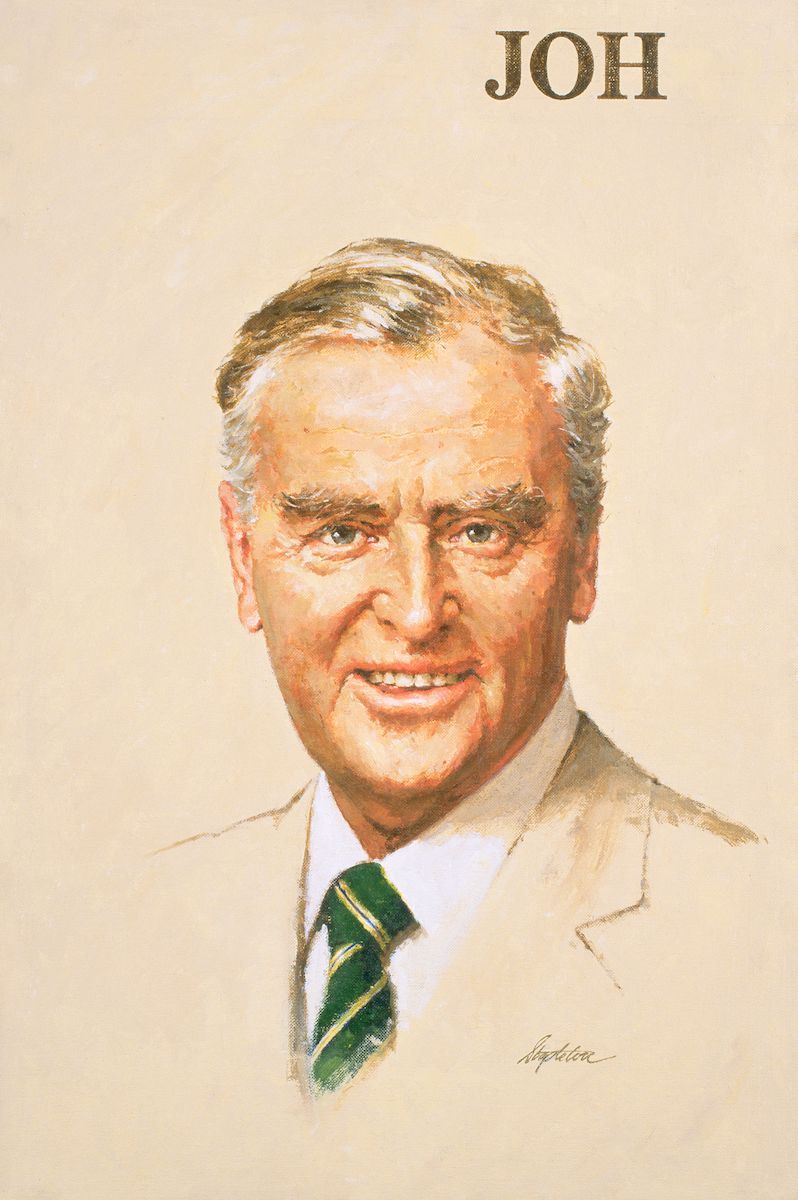
OBITUARY: Tribute to Sir Joh Bjelke-Petersen


by Victor Sirl

From News Weekly, May 21, 2005

Victor Sirl pays a personal tribute to former Queensland premier, Sir Joh Bjelke-Petersen.

Joh wasn't born in Kingaroy, but he was its favourite son. No-one cares if he was born in New Zealand. Kingaroy was his home of over 90 years and that is why he was buried at sunset in a grave amongst the pine trees on the family property, Bethany, as he had requested.

For people from Kingaroy, Joh was not just a local hero but a friend. We lived in Kingaroy for only a few years and my father first met Joh in the 1960s at a Taabinga School picnic.

Joh had two young boys working on his property and brought them along as a bit of a treat. He worked very hard and he expected hard work from his employees, but he paid them well and treated them with respect.

Challenge

There was one occasion when a worker had refused to eat at the same table as aboriginal workers. Joh told his sister to get the man a tray and then told him to eat outside! And, much to Joh's sister Neta's amusement, the man did.

Word of this - in an era when normally a white man would be inside and aborigines outside - spread through the district like a bushfire. But that was Joh. He did what he knew to be right.

Joh's favourite singer, Kamahl, sang the Lord's Prayer at his funeral and still wears a set of cuff links his old friend once gave him.

Of course, Joh met many famous people when he became Queensland premier; but before all that he was a local identity and parliamentarian from a poor background who pioneered the peanut industry.

He had lived in a cow bail for many years, invented a peanut-thresher, built a business land-clearing and peanut-harvesting, and pioneered crop-dusting. Joh attended the Lutheran Church and, at 42, began a great married partnership with Flo.

Although Joh made quite an impact on Kingaroy, no-one guessed that the qualities he demonstrated would one day enable him to transform Queensland.

As premier, he was instrumental in building the coal industry, making the Gold Coast into a tourist playground and convincing the Japanese to pour millions into the economy.

He left Queensland's booming economy with a triple-A credit rating.

An ingredient of this success was one of Joh's most controversial acts as premier - abolishing death duties. The Liberals were against it and the move was even criticised by the then Prime Minister, Malcolm Fraser.

But, as a result, people flocked to Queensland, including the wealthy so-called "white-shoe brigade", retiring to the Gold Coast.

Soon death duties, which compounded family grief, disappeared from Australia altogether because every state had to follow Joh's lead.

World Expo

Joh signed Queensland up for World Expo '88 when other states turned it down. As a result of Expo '88, the city of Brisbane was transformed forever. The South Bank complex, with its restaurants, hotels, gardens, board-walk and artificial beach, replaced derelict and unnattractive buildings.

As a politician, Joh won some incredible election victories. When he announced the 1974 election, the then ALP leader Percy Tucker yelled out the ALP campaign slogan, "Let's go", to which Joh retorted, "You'll go, all right!" In the subsequent election, Tucker lost his seat and his party representation in parliament was reduced to 11 members.

At no time while Joh was premier did the ALP ever gain over 50 per cent of the vote on a two-party preferred basis.

The Nationals, at their zenith of power, held many of the most populated seats, not just the small rural ones - a fact not widely acknowledged. This was true even before Joh's Nationals amazingly won seats in Brisbane.

But Joh's legacy to Queensland was more than just a political or economic one; it was psychological.

His former press secretary Allan Callaghan said the biggest thing Joh did for Queensland was to get Queenslanders to believe in themselves.

He told them they were living in Australia's best state - something which, today, even Labor admits. Before Joh's era, Queensland carried the tag of the "Cinderella State".

That's why, in the Sunshine State, the sun can never set on the legacy of Sir Joh Bjelke-Petersen. He has left a permanent imprint upon it, as characteristic as the Great Barrier Reef or his beloved Bunya Mountains. So many people are better off because of him.

For my family, the debt is very personal. An assistance package he once gave to dairy farmers leaving the land "kept a roof over our heads", as my mother puts it.

Sir Joh will not be forgotten - "Don't you worry about that".

  • Victor Sirl is not a member of any political party.